How to Inspect a Used Car Before You Buy: A Step-by-Step Guide for South African Buyers
With over 4,260 active used-car listings on dbauto.co.za right now — from Toyotas averaging R670,755 to budget-friendly Suzukis from as little as R59,900 — there has never been a better time to shop for a pre-owned vehicle in South Africa. But a great price means nothing if the car hides mechanical gremlins or a dodgy history. This guide walks you through exactly what to check before you hand over a single rand.
Why a Thorough Inspection Matters More Than Ever
The South African used-car market is booming. Gauteng alone accounts for 1,145 listings, followed by the Western Cape with 323 and Mpumalanga with 166. With that much choice, sellers know buyers have options — which means a well-priced car can move fast. The temptation to rush is real. Don't. A 30-minute inspection can save you tens of thousands of rands in repair bills.
Whether you're eyeing a Toyota Hilux in the R400k–R600k bracket, a Volkswagen Polo under R200k, or a Suzuki Swift for the daily commute, the same inspection principles apply.
Step 1: Do Your Homework Before You Even See the Car
Check the VIN and Service History
Every legitimate listing on dbauto.co.za includes a vehicle identification number (VIN). Before visiting the seller, run the VIN through the eNaTIS system (the National Traffic Information System) to confirm the car isn't stolen, written off, or still under finance. You can also use services like TransUnion AutoCheck or Lightstone Auto for a full vehicle history report — typically costing R100–R300 and worth every cent.
Ask the seller for the original service book. A Toyota with a full dealer stamp history commands a premium for good reason: you know exactly what's been done and when. A missing service book on a high-mileage BMW or Audi should raise immediate red flags.
Research Fair Market Value
Use dbauto.co.za's live listings to benchmark the asking price. For context, here's what the current market looks like:
- Under R100,000: 45 listings — mostly older, high-mileage vehicles
- R100,000–R200,000: 264 listings — entry-level hatchbacks and older bakkies
- R200,000–R300,000: 534 listings — solid daily drivers from Suzuki, Hyundai, and VW
- R300,000–R500,000: 1,992 listings — the sweet spot; most popular segment
- R500,000–R1,000,000: 944 listings — newer SUVs, premium bakkies, and luxury sedans
- Over R1,000,000: 314 listings — Land Cruisers, AMGs, and top-spec Hiluxes
If a car is priced significantly below its segment average, ask yourself why. A 2018 Toyota Hilux 2.4GD-6 Double Cab SRX typically lists around R399,900 on the current market. A listing at R280,000 deserves serious scrutiny.
Step 2: The Walk-Around — What to Look for Outside
Panel Gaps and Paint Consistency
Stand back and look at the car from each corner. Uneven panel gaps — where the bonnet, doors, or boot lid don't align symmetrically — often indicate previous accident damage and panel replacement. Run your hand along the body panels; ripples or rough patches under the paint suggest filler work.
Check the paint colour under bright light. Slight colour mismatches between panels (especially on the bonnet, front bumper, or doors) are a classic sign of a repray after a collision. This isn't always a dealbreaker, but it should factor into your price negotiation.
Tyres and Wheels
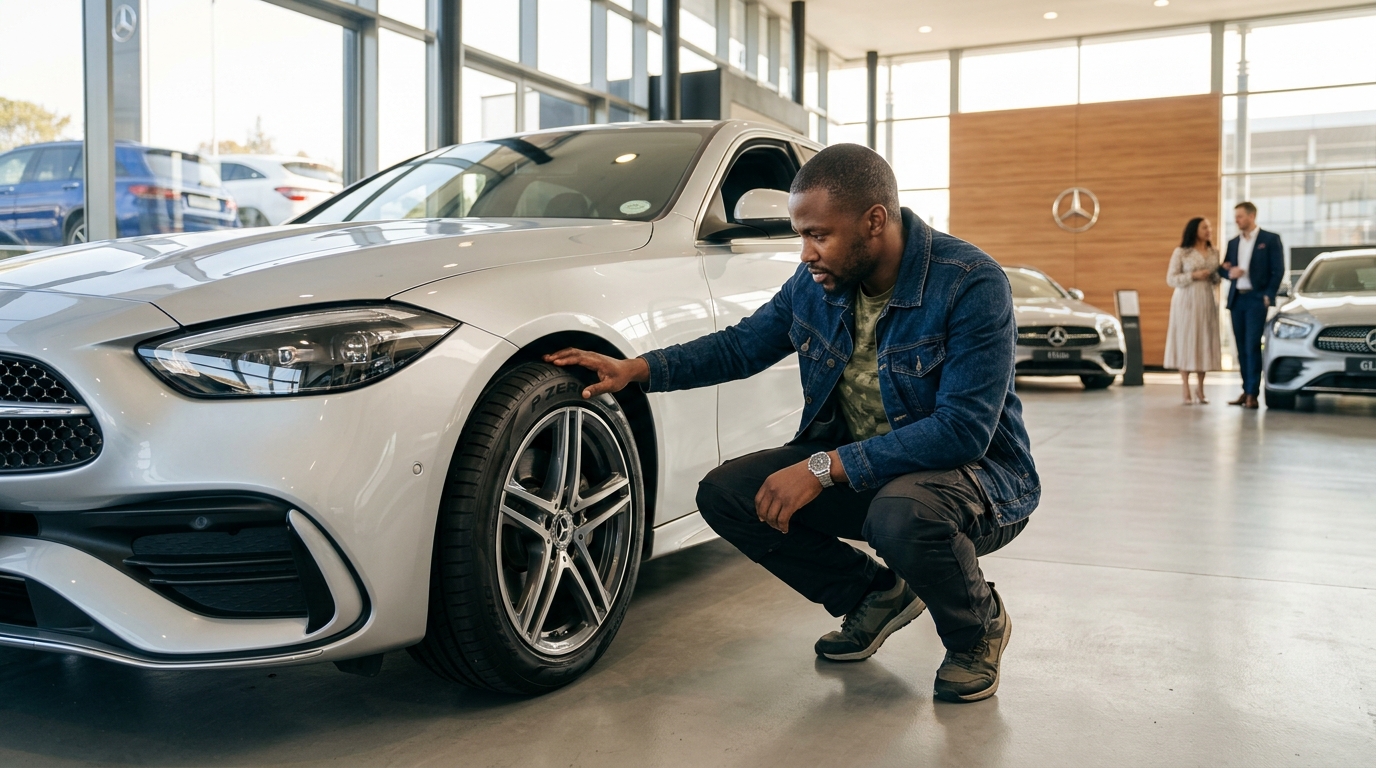
South African roads — from Joburg's potholed streets to the Northern Cape's gravel — are tough on tyres and suspension. Check tread depth on all four tyres (the legal minimum is 1mm, but anything under 3mm means you'll be replacing them soon). Uneven wear patterns tell a story: wear on the inner or outer edges suggests wheel alignment or suspension issues; cupping or scalloping points to worn shock absorbers.
Inspect the alloy wheels for kerb rash and cracks. A cracked alloy is a safety issue, not just a cosmetic one.
Underneath the Car
If you can, crouch down and look under the vehicle. Fresh oil stains on the ground beneath the engine bay or gearbox are a warning sign. Check the exhaust for rust, holes, or excessive soot — a sooty tailpipe on a diesel can indicate injector problems or a worn engine.
Step 3: Under the Bonnet — The Engine Check
You don't need to be a mechanic to spot the most common red flags under the bonnet.
Oil and Coolant Levels
Pull the oil dipstick. The oil should be amber to light brown and sit between the min and max marks. Black, gritty oil suggests the car is overdue for a service. Now check the coolant reservoir — it should be clear or slightly tinted, never rusty or milky. A milky appearance (like a latte) is a serious warning: it often means a blown head gasket, which can cost R15,000–R40,000 to repair.
Battery and Belts
Check the battery terminals for corrosion (white or blue-green crust). Inspect the serpentine belt and timing belt (if visible) for cracks or fraying. On many South African-market vehicles — particularly older Toyotas and Fords — a worn timing belt that snaps can destroy the entire engine.
Start the Engine Cold
Ask the seller not to warm the car up before your visit. A cold start reveals a lot. Listen for:
- Knocking or tapping — could indicate worn bearings or low oil pressure
- Excessive smoke — blue smoke means burning oil; white smoke (on a warm day) can mean coolant entering the combustion chamber
- Rough idle — may point to misfires, dirty injectors, or vacuum leaks
Step 4: The Test Drive — Don't Skip This
A test drive is non-negotiable. Aim for at least 20 minutes covering a mix of urban stop-start traffic and an open road stretch. Here's what to assess:
Brakes
Apply the brakes firmly at around 60 km/h. The car should stop in a straight line without pulling to one side. A pulsating brake pedal suggests warped discs; a grinding noise means the pads are worn to metal.
Steering and Suspension
Drive over a speed bump slowly and listen for clunks or rattles — these often indicate worn shock absorbers, ball joints, or tie rod ends. On a straight, flat road, briefly release the steering wheel. The car should track straight; if it pulls, the alignment is off.
Gearbox and Clutch
For manuals, the clutch should engage smoothly without slipping. A clutch that bites very high (near the top of the pedal travel) is nearing the end of its life. For automatics, gear changes should be smooth and prompt — hesitation, shuddering, or a delay when selecting Drive or Reverse can signal expensive transmission work ahead.
Air Conditioning
In South Africa's climate, a working aircon is essential. Switch it on and check that it blows cold within 60 seconds. A regas costs around R800–R1,500; a compressor replacement can run R8,000–R20,000.
Step 5: Get an Independent Pre-Purchase Inspection
Even if everything looks good, spending R800–R1,500 on an independent pre-purchase inspection (PPI) from a reputable workshop is one of the smartest investments you can make. A qualified mechanic will put the car on a lift, check the chassis for accident damage, test the electronics, and give you a written report. Many buyers use this report as leverage to negotiate the price down.
Most AA-approved workshops and franchise dealers offer PPIs. For private sales — which make up a significant portion of listings on dbauto.co.za — this step is especially important, as private sellers are not bound by the same consumer protection obligations as registered dealers.
Step 6: Paperwork and Payment
Once you're satisfied with the car, make sure the paperwork is in order:
- Roadworthy certificate (RWC): Required for the transfer of ownership in South Africa. Confirm it's current and issued by a licensed testing station.
- Licence disc: Check the expiry date. Renewing a licence disc is straightforward, but outstanding traffic fines linked to the vehicle become your problem once you take ownership.
- FICA documents: For private sales, both buyer and seller need valid ID. For dealer purchases, the dealership handles the transfer paperwork.
- Never pay cash without a receipt — use an EFT and keep the proof of payment.
Ready to Find Your Next Car?
South Africa's used-car market offers incredible value right now. With Toyota dominating the listings (1,061 vehicles), followed by Suzuki (399), Volkswagen (317), BMW (249), and Ford (241), there's something for every budget and lifestyle on dbauto.co.za.
Use this guide as your checklist, take your time, and don't let urgency pressure you into a bad decision. The right car at the right price is out there — and with over 4,260 active listings updated daily, your next great deal is just a search away.